IDM - Identity Manager
Powered by
| Project Links |
|---|
| Software GitHub Repository https://github.com/ds2-eu/identity |
| Progress GitHub Project https://github.com/orgs/ds2-eu/projects/8 |
General Description
The DS2 Identity Module (IDM) is a Foundation module that provides a practical framework for creating, managing, and validating participant and module identities for inter-Dataspace activities. It leverages Verifiable Credentials (VCs) and integrates with technologies like the EDC IdentityHub to ensure secure and trustworthy identity management. The IDM aims to reuse existing identities from different companies and provide robust mechanisms to verify their membership and participation in various dataspaces.
The IDM facilitates the secure interaction between dataspaces by managing identities and access rights. Key development efforts have focused on:
- Verifiable Credentials (VCs): Core to the IDM, VCs allow companies to prove their identity and attributes in a secure and verifiable manner.
- Wallet Visualisation: Functionality enabling companies to view and manage their VCs.
- Credential Issuer: DS2 has developed its own credential issuer capable of generating signed VCs for companies, based on dataspace agreements.
- IDM Portal: A comprehensive web interface (backend and frontend) for managing dataspaces, collaboration agreements, and company registrations within DS2.
- EDC IdentityHub Integration: Successful integration allows for the hosting and management of VCs.
- DAPS (Dynamic Attribute Provisioning Service): Omejdn-based DAPS for IDS connector authentication and dynamic attribute provisioning.
- Object Storage: MinIO-based storage for file uploads and credential data.
The module supports the registration of dataspaces, the establishment and management of collaboration agreements between them, and the registration of companies as DS2 members, all underpinned by a system of verifiable digital credentials.
Architecture
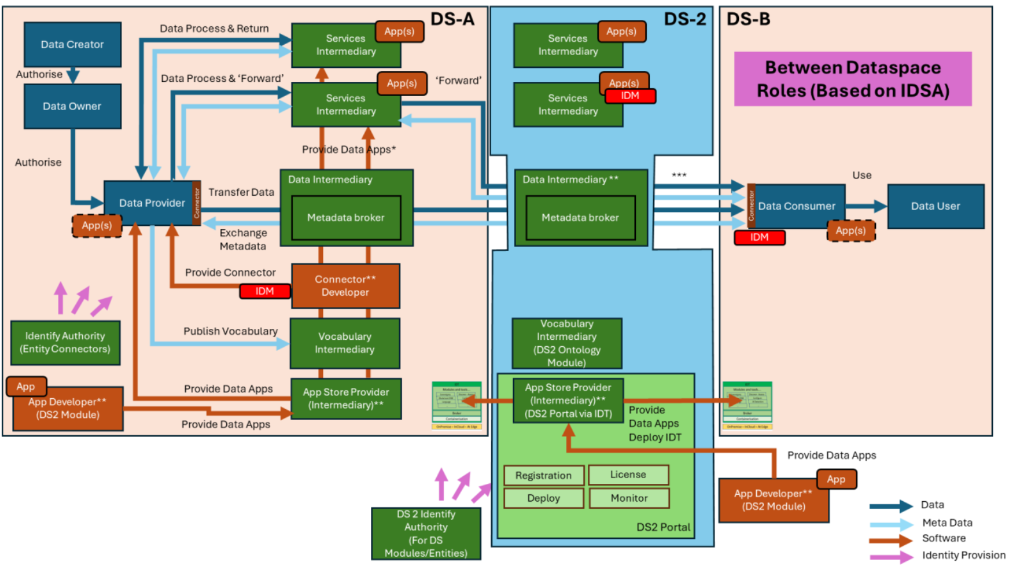
The figure below represents the module fit into the DS-DS environment.
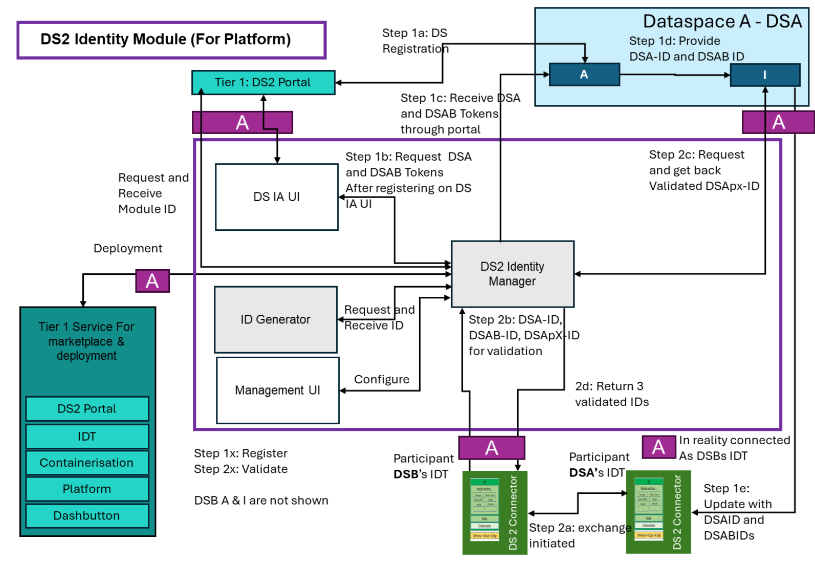
The figure below represents the actors, internal structure, primary sub-components, primary DS2 module interfaces, and primary other interfaces of the module.
Component Definition
The IDM comprises the following key components:
IDM Portal:
- Backend (idm-rest): A Python FastAPI service managing the business logic for dataspace registration, agreement workflows, company registration, and interactions with the credential issuer and wallet functionalities.
- Integrates with MongoDB for data persistence, MinIO for object storage, and Keycloak for authentication.
- Exposes REST endpoints for Authentication, Catalogs, Collaboration, Connector Credentials, Configurations, Credentials, Dataspaces, DRM Policy Logs, Issuer, Membership Requests, Organizations, Participants, Seed Data, Tags, and Upload Files.
- Frontend (idm-app): A Vue.js 3 application providing user interfaces for:
- Registration of dataspaces in DS2.
- Requesting collaboration and forming agreements between dataspaces.
- Searching for registered dataspaces.
- Accepting or rejecting collaboration agreements.
- Visualizing dataspace policies.
- Registering companies as members of DS2.
- Requesting and viewing peer credentials.
- DS2 Credentials Issuer: An implemented service capable of generating cryptographically signed Verifiable Credentials.
- Issues credentials to companies based on established dataspace agreements and their DS2 membership.
- Wallet Visualisation Functionality: A user-facing component allowing companies to view and manage their issued Verifiable Credentials.
- Integrated with the EDC IdentityHub for hosting credentials.
- EDC IdentityHub Integration Layer: Manages the interaction with the EDC IdentityHub, enabling the storage and retrieval of Verifiable Credentials.
- DAPS (omejdn-daps): Omejdn-based Dynamic Attribute Provisioning Service for IDS connector authentication, built on Omejdn Server with Config API and plugin support.
- Object Storage (idm-minio): MinIO-based S3-compatible object storage used for file uploads and storing credential-related assets.
- Database (idm-database): MongoDB database with replica-set support for storing IDM data, including dataspaces, organizations, users, credentials, and collaboration agreements.
- Core Identity Logic: Underlying mechanisms for verifying membership of companies in their respective dataspaces and managing the lifecycle of identities and credentials within the DS2 ecosystem.
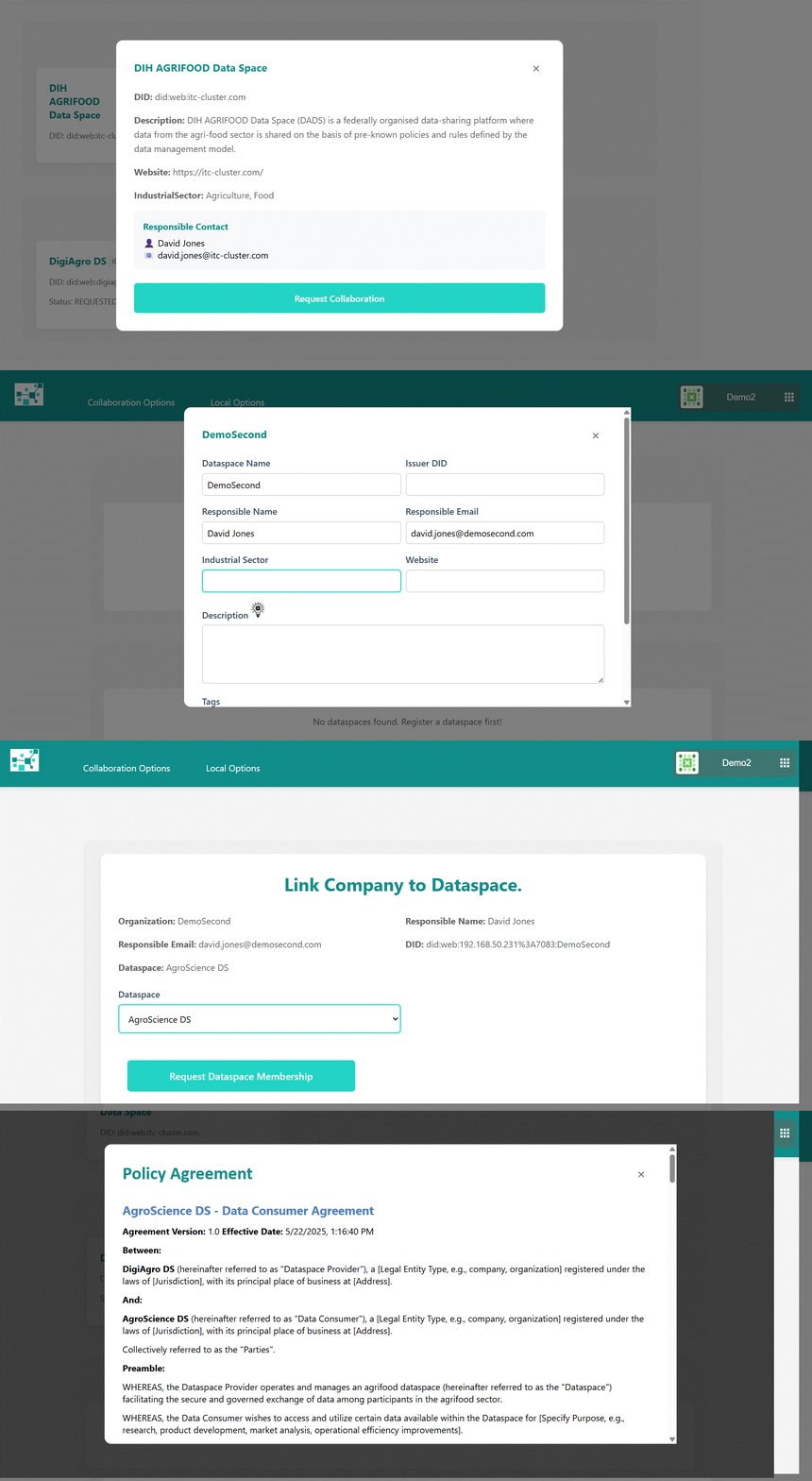
Screenshots
Commercial Information
Table with the organisation, license nature (Open Source, Commercial ... ) and the license. Replace with the values of your module.
| Organisation (s) | License Nature | License |
|---|---|---|
| ICE | Open Source | Apache 2.0 |
Top Features
- Verifiable Credential Management: Core functionality for issuing, hosting (via EDC IdentityHub), and visualizing VCs for companies.
- DS2 Native Credential Issuer: Custom-built service to generate signed credentials based on dataspace agreements.
- Comprehensive IDM Portal:
- Dataspace registration and discovery.
- Inter-dataspace collaboration agreement management (requests, acceptance/rejection).
- Visualization of dataspace policies.
- Company registration for DS2 membership.
- Peer credential request and wallet view.
- EDC IdentityHub Integration: Successfully achieved for robust VC hosting.
- Wallet Functionality: Allows companies to manage and present their digital credentials.
- DAPS Connector Authentication: Omejdn-based DAPS for IDS connector identity and dynamic attribute provisioning.
- Object Storage: MinIO-based S3-compatible storage for file uploads and credential assets.
- Keycloak Authentication: SSO integration for user authentication and authorization.
- Decentralized Identity Principles: Aligns with modern approaches to identity management, enhancing security and user control.
- Membership Verification: Mechanisms to verify company membership within specific dataspaces.
- Secure Inter-Dataspace Communication: Facilitates trust by ensuring participants are authenticated and authorized.
How To Install
The module is installed as part of the IDT.
Requirements
Provision a Linux VM (Ubuntu 24.10) Docker installed
Resources: Recommended: 4 cpu cores, 8 GB RAM and 50 GB disk capacity.
Summary of installation steps
Steps consider the download, compilation and deployment of the different parts of the software.
Detailed steps
Clone the code
The module is composed of the following parts:- idm-app: Vue.js 3 frontend of the app providing functionality for creating dataspaces, establishing collaboration agreements, and requesting verifiable credentials.
- idm-rest: Python FastAPI backend REST API for the IDM Portal to interact with the database, MinIO, EDC IdentityHub, and the Verifiable Credentials Issuer.
- idm-database: MongoDB database for storing the IDM data.
- idm-minio: MinIO object storage for file uploads and credential assets.
- omejdn-daps: Omejdn-based DAPS for IDS connector authentication and dynamic attribute provisioning.
Run the command
How To Use
The IDM is primarily interacted with via the global portal. After the user logs in it provides two main functionality: Management of Dataspaces and Company Verifiable Credentials:
- Dataspace Authorities:
- Use the IDM Portal to register their dataspace within the DS2 ecosystem.
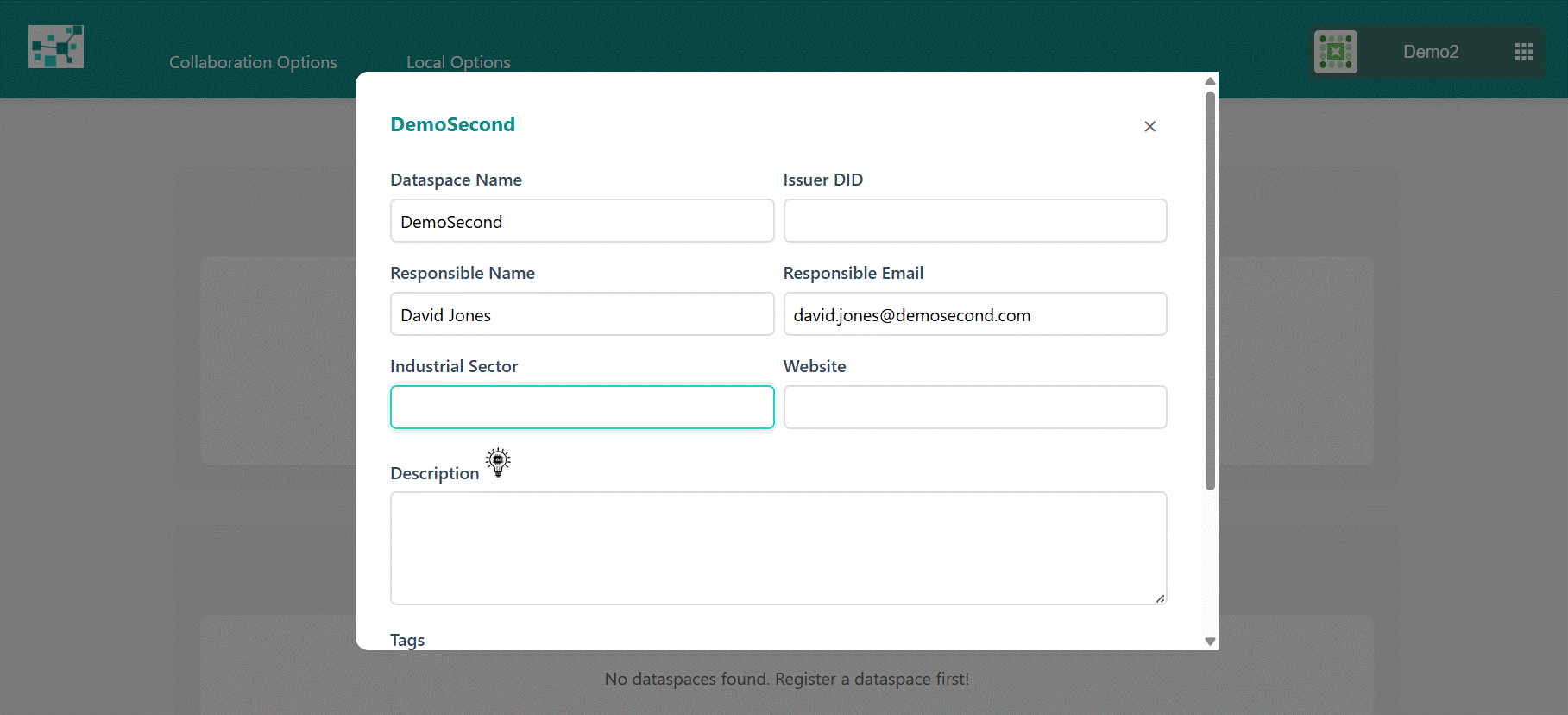
- Search for other registered dataspaces to explore potential collaborations.
- Initiate collaboration requests with other dataspaces.
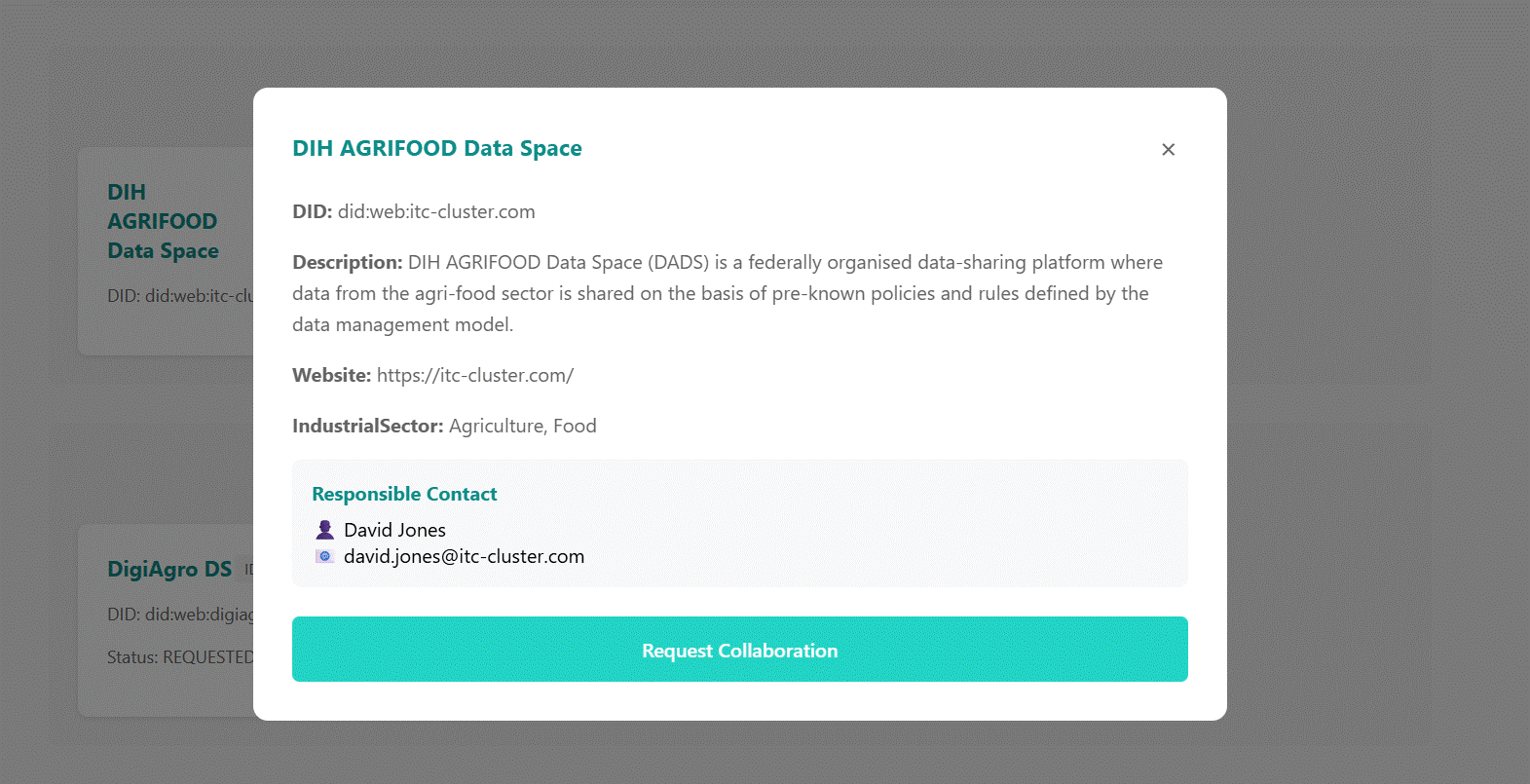
- Review and accept/reject incoming collaboration requests.
- View policies associated with registered dataspaces.
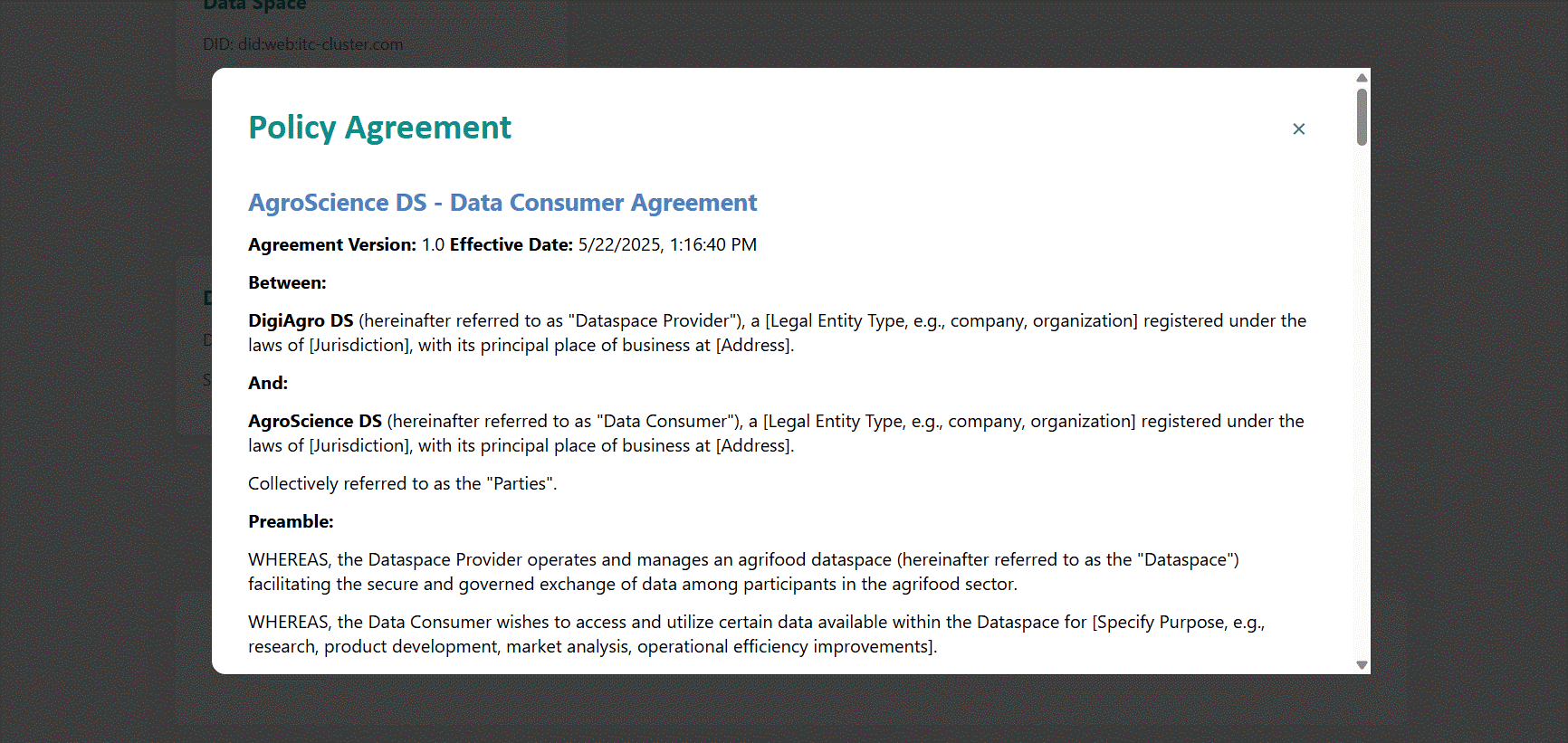
- Use the IDM Portal to register their dataspace within the DS2 ecosystem.
- Companies:
- Register their organization as a member of DS2 via the IDM Portal.
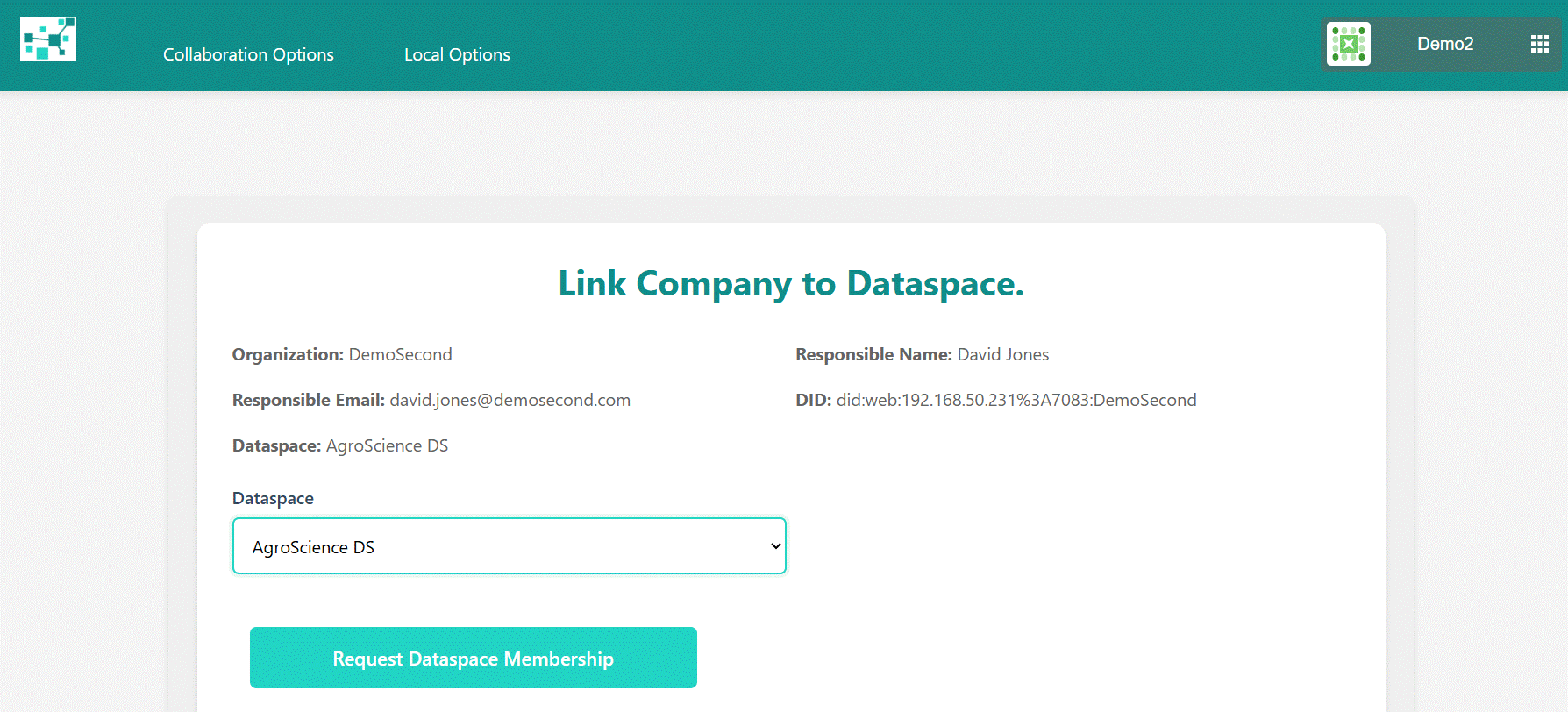
- Once approved and relevant dataspace agreements are in place, the DS2 Credentials Issuer will generate Verifiable Credentials for the company.
- Access the Wallet Visualisation Functionality to view and manage their issued VCs. These VCs can then be used to prove their identity and membership in inter-dataspace interactions.
- Register their organization as a member of DS2 via the IDM Portal.
- System Administrators:
- Manage the overall configuration and operation of the IDM components.
Other Information
No other information at the moment for IDM
OpenAPI Specification
The IDM REST API exposes an auto-generated OpenAPI specification and interactive documentation:
- Swagger UI:
http://localhost:48087/idm-api/docs - ReDoc:
http://localhost:48087/idm-api/redoc - OpenAPI JSON:
http://localhost:48087/idm-api/openapi.json
Additional Links
- IDM GitHub Repository: https://github.com/ds2-eu/identity
- IDM Progress Project: https://github.com/orgs/ds2-eu/projects/8